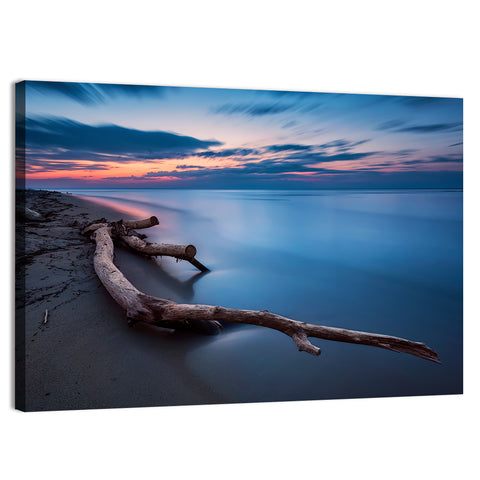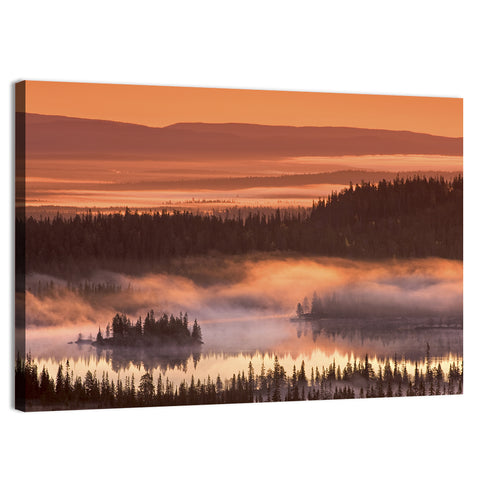


To declutter living room walls, take down the small frames you no longer love and hang one calm piece of wall art, sized to two thirds to three quarters of the sofa's width. One large piece lets the eye settle in one place, so the room reads as ordered even when the shelves are full.
- Clear the wall in a fixed order: take the frames down, sort them, then hang one piece, so you never rearrange the same wall twice.
- One 36x24 to 60x20 inch piece above the sofa calms a wall better than a cluster of small frames.
- Size the piece to two thirds to three quarters of the furniture below it, and hang it 6 to 10 inches above a sofa back.
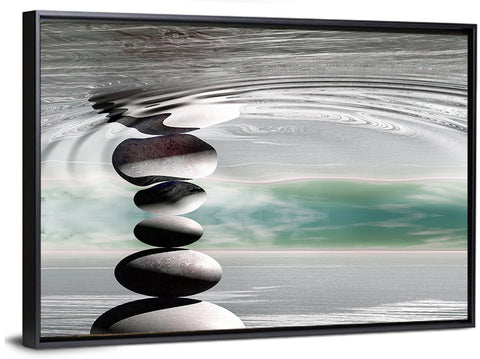
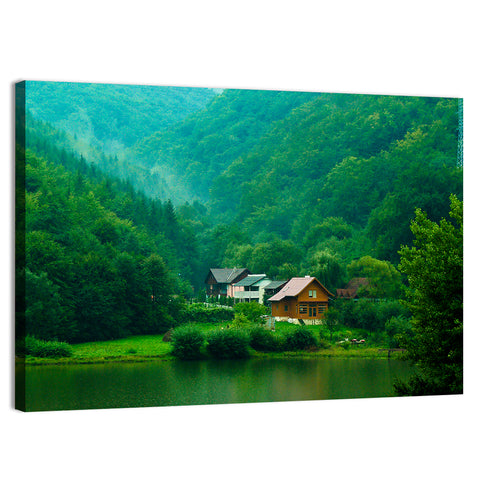
- Choose a quiet subject, such as a misty lake, sand dunes or a pared-back abstract, and pull one color from the room.
- Leave open wall around the piece, because the space around art is part of what makes a room feel calm.
How Do You Declutter a Living Room Wall of Frames?
Treat the wall like any other surface in the room: take everything off, decide what earns its place and put back one thing. A wall of frames is a short job, and the order matters more than the speed, because the bare wall shows you how much space one piece of art really needs.
- Photograph the wall as it is, so you can see which frames you would keep.
- Take down every small frame and lay them on the floor, grouped by color and subject.
- Sort them into keep, store, donate and give away. Handle each frame once and decide in under ten seconds.
- Leave the wall bare for a day and look at the empty space before you choose anything new.
- Measure the sofa or console and multiply its width by 0.66 and 0.75 to find the width of the one piece you will hang.
- Hang the new piece 6 to 10 inches above the sofa back, then step back across the room before you add anything else.

Pro tip: Set a timer for 25 minutes and stop when it rings. Taking frames down is quick, but choosing the replacement stalls when the task feels endless, and a clear stopping point keeps you moving.
Which Living Room Walls Need Fewer Pieces First?
Start with the walls that collect the most frames and show the most. Use these limits as a target, then adjust to the room.
| Wall | Common wall clutter | Target | Where the rest goes |
|---|---|---|---|
| Above the sofa | A loose cluster of small frames | 1 piece, two thirds to three quarters of the sofa width | Store flat in a box |
| Above a console | A hung frame plus frames leaning in front of it | 1 piece, centered on the console | Donate or move to a hallway |
| Over a mantel | Frames propped in a row | 1 piece, centered | Store flat in a box |
| Beside a window | Small prints squeezed into a narrow gap | 1 portrait piece or bare wall | Move to another room |
| Entry or hallway | Frames of mixed sizes up the wall | 1 anchor piece | Donate the rest |
A long wall can take two pieces of equal size with the same gap between them, but each one should still be sized to the furniture beneath it. Two matching frames beside a large print compete for attention, so pick one anchor and let it lead.

What Are the Biggest Mistakes When You Declutter Wall Art?
The common mistakes come from starting without a plan. Buying a new piece before the old frames are down is the top one, because a new image added to a crowded wall just adds to the noise. Hanging a piece that is too small is another: a 16 inch print on a wide wall looks like a leftover.
- Clear the wall before you choose a new piece, so you know the space you are filling.
- Measure the sofa or console first and size the piece to two thirds to three quarters of its width.
- Decide on each frame the first time you take it down, not the second.
- Take the donation bag with the old frames out of the house the same day.
- Do not stop at the tables: a bare coffee table under a crowded wall of frames still feels busy.
Watch out: A decluttered room with nothing on the wall can feel cold. Do not strip the room until it echoes; keep one meaningful piece of art on the main wall and let it carry the calm.
Is One Piece of Art Enough for a Living Room Wall?
Yes. Walls collect clutter just as tables do, and a gallery of mismatched frames reads as noise. One considered piece does the work of ten small ones, because the eye settles in one place. Our guide to small changes that refresh a room covers more steps like this.
Take down the small frames you no longer love and store them in a flat box. Leave the wall bare for a day. Then hang one piece sized to the sofa, about two thirds to three quarters of its width, and see how much calmer the room feels.

How Do You Finish a Decluttered Living Room With One Piece of Art?
Pick one piece that is large, calm and drawn from the room's palette, and hang it above the main furniture. A quiet landscape, a misty lake or a pared-back abstract suits a cleared room. Our minimalist wall art follows that approach, and neutral wall art sits easily with beige and gray rooms.
Size and height decide whether the piece looks planned. Hang it 6 to 10 inches above the sofa back, with its center near 57 to 60 inches from the floor when nothing is below. Use a 60x40 inch landscape or a 60x20 inch panoramic over an 84 inch sofa, and a 36x24 inch landscape over a 48 inch console.
Take an 84 inch sofa with a back height of 34 inches and a wall holding five small frames of different sizes. Once the frames are down and stored flat, two thirds of the sofa width is 56 inches and three quarters is 63 inches, so a 60x20 inch panoramic canvas fits. Hang its bottom edge 8 inches above the sofa back, at 42 inches. The top edge lands at 62 inches and the center at 52 inches, and the wall now holds one piece instead of five.

Which Finish Suits a Calm Living Room: Canvas, Framed or Poster?
All four finishes carry the same image, so choose by the edge you want on a clear wall. A frame adds a line around the picture, and a Canvas Print has none. This table sorts the four by the kind of calm they give.
| Finish | What it is | Suits a calm living room when |
|---|---|---|
| Canvas Print | Printed on canvas, stretched over a wooden inner frame, ready to hang | You want a soft edge with no frame line |
| Framed Canvas | A canvas print with a frame around it | Other pieces in the room are framed and you want them to match |
| Framed Print | A print with a frame around it | The image is quiet and graphic, such as dunes or a seascape |
| Poster Print | A print on paper | You want the plainest, flattest look on the wall |
Light the piece from the side, with a lamp or a window, rather than from straight in front. Glare across the surface flattens the image, and a calm picture needs its soft tones to show.
What Makes a Living Room Wall Look Dated or Cluttered?
Too many competing patterns and colors age a room faster than any single trend. A grid of identical frames, a mix of frame colors and a wall filled to its edge all read as dated. Fewer pieces, one confident image and open wall around it read as current.
Colors cause the most mistakes. Choose two main colors and one accent, then pull one of them from the art. A piece with soft gray, sand and sage works in a room with a gray sofa, while a bright red piece fights with it. Our small space decorating ideas show how color and scale work in tight rooms.

One in, one out keeps the wall clear after the first reset: when a new piece goes up, an old frame comes down instead of joining it. For a lower cost way to refresh the wall, our budget-friendly wall decoration ideas show how to change a wall without buying much.
Every piece is printed to order and ships free across the US. A single calm piece finishes a cleared room.
Minimalist wall art Neutral wall art Japandi art Modern organic wall art
Quick answers
Common Questions
How many pieces of wall art should a living room wall have?
For a calm look, hang one large piece per main wall. A piece sized to the furniture below it does the work of a cluster of small frames, because the eye settles in one place. Add a second piece only on a separate wall, or beside the first with equal spacing.
What size wall art goes above a sofa?
Aim for about two thirds to three quarters of the sofa's width. Over an 84 inch sofa that is 56 to 63 inches, so a 60x20 inch panoramic or a 60x40 inch landscape fits. Hang the bottom edge 6 to 10 inches above the sofa back so the piece reads as one group with the furniture.
How high should you hang art in a living room?
Center the piece near 57 to 60 inches from the floor when nothing is below it. Above a sofa or console, hang the bottom edge 6 to 10 inches above the furniture instead. Step back across the room and look from the seat before you mark the final nail.
What wall art suits a minimalist living room?
A quiet landscape, a misty lake, sand dunes or a pared-back abstract in two or three soft colors. Choose a piece that repeats one color from the room, and leave open wall around it so the image has space. A Canvas Print has no frame line, which keeps the wall plain.
Should you declutter your walls as well as your tables?
Yes. A bare table under a crowded wall of small frames still feels busy. Take down the frames you no longer love, store them flat and hang one piece of art sized to the furniture. Then keep three or fewer objects on each table and leave a third of every shelf open.