

How to choose art for a room comes down to five decisions: size, mood, color, shape and finish, then a paper test. Make the art two thirds to three quarters as wide as the furniture below it, match the scene to the room's job, repeat one color, and hang the center 57 to 60 inches from the floor.
- Art should be two thirds to three quarters as wide as the furniture below it: 56 to 63 inches over an 84 inch sofa, 40 to 45 inches over a queen bed.
- Hang the center of a piece on open wall 57 to 60 inches from the floor, and leave 6 to 10 inches between a sofa or console and the bottom edge of the art.
- Canvas sizes run up to 60x40 inches in landscape, 60x20 in panoramic, 30x60 in portrait and 48x48 in square, so one large piece can fill a wide wall.
- A pale wall needs art that carries color and a dark wall needs art with light in it: Pantone's 2026 pick, Cloud Dancer, is a soft white, and Benjamin Moore's, Silhouette, is a rich espresso.
- Tape paper cut to the piece's size on the wall before you order: a change of mind carries a 50% restocking fee, and delivery takes 8 to 10 business days.
How to Choose Art for a Room in Five Steps
Magnolia's art guide frames the choice as style, space and scale. Space and scale come first here, because you can measure them, and style is easier to judge once the size is fixed. Work through these five steps in order.
- Measure the width of the sofa, bed or open wall in inches, and aim for art two thirds to three quarters as wide.
- Name the room's job (rest, talking, eating or working) and choose a scene that supports it.
- Pull one color from the sofa, rug or floor, and check how the art meets the wall color.
- Pick the shape that fits the wall, then the finish: Canvas Print, Framed Canvas, Framed Print or Poster Print.
- Cut paper to the piece's size, tape it up for a weekend, then hang the real piece with its center at 57 to 60 inches.

How Big Should Art Be for a Room?
Art should be two thirds to three quarters as wide as the furniture it hangs over. That is 56 to 63 inches above an 84 inch sofa and 40 to 45 inches above a queen bed. On a bare wall, apply the same fraction to the gap between the nearest corners, doors or windows.
| Hangs over | Furniture width | Art width to aim for | Sizes that fit |
|---|---|---|---|
| Large sofa | 84 in | 56 to 63 in | 60x40 landscape, 60x20 panoramic |
| Small sofa | 72 in | 48 to 54 in | 48x32 landscape, 48x16 panoramic |
| Queen bed | 60 in | 40 to 45 in | 36x24 landscape (a little under), 48x32 landscape (a little over) |
| Sideboard | 48 in | 32 to 36 in | 36x24 landscape, 36x12 panoramic |
| Entry console | 36 in | 24 to 27 in | 24x24 square, 24x16 landscape |
| Narrow wall | 30 in | 20 to 22 in | 20x40 portrait |
Watch out: A piece narrower than half the furniture looks lost, whatever the image. If you love a small size, give it a smaller job: a picture ledge, a console or a narrow stretch of wall.
Your sofa is 90 inches wide, its back is 34 inches high and the ceiling is 8 feet. Two thirds of 90 is 60, so a 60 inch wide piece fits. A 60x40 landscape hung 8 inches above the sofa runs from 42 to 82 inches and leaves 14 inches below the ceiling. The 60x20 panoramic runs from 42 to 62 inches, with its center at 52, and leaves the upper wall clear. Choose the panoramic.

Which Art Suits Each Room?
Match the scene to what the room is for: low contrast where you rest, one bold scene where you talk, warm color where you eat and one clear image where you only pass through.
Living Room
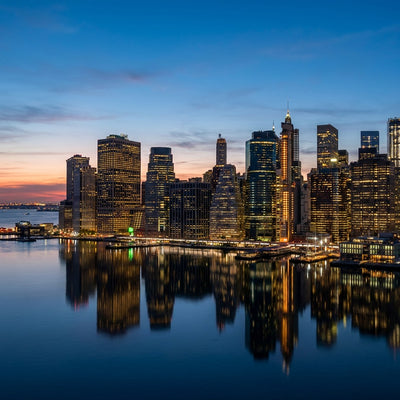
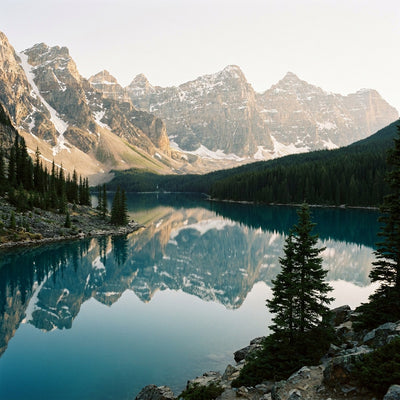
A living room takes the boldest piece in the house, sized to the sofa. A skyline at dusk, a lake at sunset or a mountain range reads from across the room, and our skyline wall art adds city energy.
Bedroom
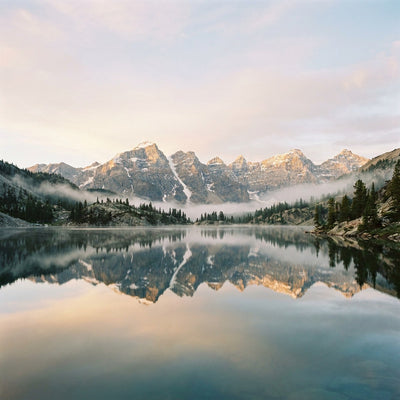
A bedroom wants a clear horizon and soft contrast: a still lake, a pale meadow or a misty ridge in blue, gray or gold. Hang it 8 to 12 inches above the headboard, where you see it from the pillow. Our nature wall art has plenty of calm scenes.

Kitchen and Dining Room
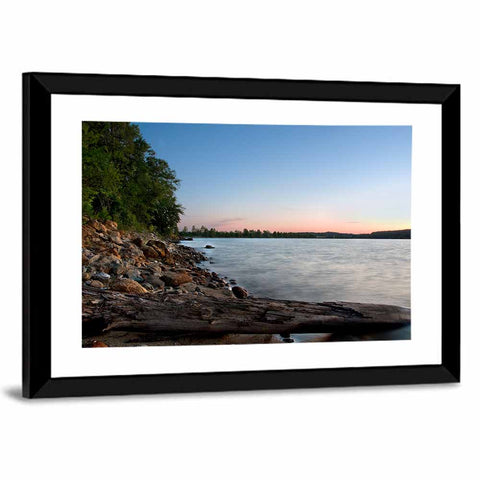
Warm color suits rooms where people eat: a gold sunset, autumn trees or a coast in sand and blue. Over a 48 inch sideboard, a 36x24 inch landscape fits, and coastal wall art brightens a kitchen.
Entryway and Hall
An entry gets a few seconds of attention, so use one clear image: a 24x24 inch square over a 36 inch console, or a 12x24 inch portrait on a narrow hall wall.
Kids' Rooms
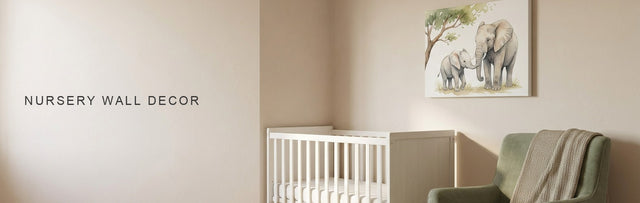
Choose a cheerful, simple scene sized to the dresser or the bed, and keep anything heavy or glass away from a crib. Our nursery wall decor guide covers safe placement.
How to Choose Wall Art That Matches Your Wall Color
Let the wall decide how much color the art must carry: a pale wall needs art with color in it, and a dark or saturated wall needs art with light in it. Pick up one color from the sofa, rug or floor, and let the art add one contrast.
Designers who use the 70/30 rule give about seven parts of a room to one anchor scheme (walls, sofa, rug) and three to contrast. Art is the easiest place to put the three, since it is the one part of the scheme you can swap without repainting or buying furniture. Three 2026 colors of the year show how it works.
| 2026 wall color | What the art should do | Scenes to try |
|---|---|---|
| Cloud Dancer (Pantone), a soft white | Carry the room's main color | Dusk skyline, blue and gold lake |
| Hidden Gem (Behr), a smoky jade green | Add warm contrast | Red rock sunset, autumn foliage |
| Silhouette (Benjamin Moore), a rich espresso | Bring light to the dark | Sunlit peaks, pale dusk sky |
On a jade wall, a red rock sunset gives the contrast, because warm and cool colors sit opposite each other on the color wheel and each looks stronger beside the other. Then repeat one color from the art in a pillow or lamp base, and the piece looks planned.

What Type of Art Is in Demand Right Now?
Nature scenes in warm or saturated color, hung as one large piece, are where the 2026 evidence points. FinerWorks' June 2026 trend roundup, which draws on Houzz and The Spruce, lists nature-inspired art (landscapes, botanical prints and coastal scenes), warm earth tones and bold color among the year's directions.

Treat this as direction, not proof: FinerWorks is a print business. A style already in your room narrows the choice faster, and our farmhouse wall decor guide, for example, points to barns, fields and country roads.
Which Shape and Finish Should You Choose?
Choose the shape from the wall and the finish from the room. Landscape suits most sofa and bed walls, with canvas sizes from 12x8 to 60x40 inches. Panoramic suits a long, low wall, from 24x8 to 60x20. Portrait suits a narrow wall or a stairwell, from 8x16 to 30x60, and square suits a console or a compact spot, from 12x12 to 48x48. Browse panoramic wall art for scenes that stretch along a sofa.
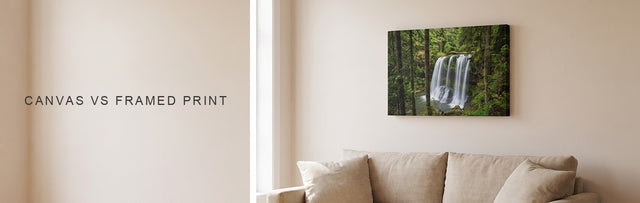
A Canvas Print is stretched over a solid wooden inner frame and arrives ready to hang, and a Framed Canvas comes in the same sizes up to 60x40. A Framed Print is a paper print in a frame, up to 36x24 in landscape, and a Poster Print is paper, up to 54x36. Canvas suits a large, relaxed wall, and a framed piece suits a small, formal spot such as a hall or study. Our canvas vs framed print guide compares them side by side.
How to Buy Art for a Room Without Guessing the Size
Test the size at full scale before you order, then check the details on the product page. A paper template costs nothing and shows scale better than any measurement.
Pro tip: Cut kraft paper, or tape sheets of newspaper together, to the exact size of the piece. Fix it to the wall with painter's tape, its center at 57 to 60 inches, and live with it for a weekend. If it looks lost, go up one size; if it crowds a lamp or a window, go down one.
- Confirm the piece comes in the size and shape you tested, since not every piece offers every size.
- Check the finish on the page you order from, because each finish has its own largest size.
- Count back 8 to 10 business days from the date you need it. Free Shipping applies to every US order.
- Read the return terms: 30 days from delivery, a 50% restocking fee for a change of mind, and a free replacement for a damaged or wrong piece.
Every piece is printed to order in four finishes and four shapes, with Free Shipping on every US order. Start with the width you measured and the job the room does.
Nature wall art Lake wall art Skyline wall art Coastal wall art Panoramic wall art
Quick answers
Common Questions
How do you display artwork in a room?
Hang one large piece over the main furniture, with its center 57 to 60 inches from the floor and its bottom edge 6 to 10 inches above a sofa or console. Lean a smaller piece on a picture ledge, or group three or five separate pieces on a long wall with 2 to 3 inches between them. Keep each hung piece about two thirds as wide as the furniture below.
What is the rule of 57 for hanging art?
The rule of 57 says to hang art with its center 57 inches from the floor, a height many galleries use because it sits near average eye level. With high ceilings or tall people, 60 inches works as well. Above furniture, the furniture sets the height instead: 6 to 10 inches over a sofa and 8 to 12 inches over a headboard.
What is the 3-5-7 rule in decorating?
The 3-5-7 rule says to group objects in odd numbers (three, five or seven), because an odd group looks less stiff than a matched pair. On a wall, that means three, five or seven separate pieces, with 2 to 3 inches between neighbors and one piece clearly larger than the rest. It is a guideline, and a single large piece needs no grouping at all.
What is the 70/30 rule in art?
The 70/30 rule says one dominant color, shape or value should fill about seven parts of a composition, with a contrasting accent filling the other three. Designers who use it for rooms let the walls and furniture carry the seven and the art and accessories carry the three. Treat the numbers as a starting point, not a formula.
Where should you not hang pictures?
Avoid direct sunlight, which fades any print over time, and spots near a fireplace, radiator, stove or heating vent, where heat is hard on frames and canvas. Skip steamy bathrooms, where moisture marks paper, and narrow walkways where frames get knocked. Do not hang art far above furniture or eye level either, because it floats.