


How to hang canvas art depends on weight: one hook or a sawtooth hanger for a light canvas, two hooks for a medium one, and screws into studs or rated anchors for a large one. Weigh the piece first, choose hardware rated for twice that weight, and center the art 57 to 60 inches from the floor.
- Weigh the canvas on a bathroom scale, then buy hardware rated for at least twice that number.
- Past 24 inches wide, use two fixing points, because a single hook lets the canvas pivot and tilt.
- Studs usually sit 16 inches apart on center, and a screw into one holds more than most drywall anchors.
- Plaster needs an X of painter's tape and a pilot hole; brick needs a masonry bit aimed at the mortar joints.
- The hook sits below the top edge by the drop to the wire: a 48x32 canvas centered at 58 inches gets hooks at 71 inches.
How Do You Match Hanging Hardware to Canvas Weight?
Weigh the canvas first, because weight decides every other choice. Step on a bathroom scale holding the canvas, step on again alone, and subtract the two readings.
Then sort it into a band. Under about 6 pounds, one hook or a sawtooth hanger is enough. Between 6 and 12 pounds, use two hooks. Above 12 pounds, use two screws into studs or anchors rated for the load. In every band, buy hardware rated for at least twice the weight, so a 9 pound canvas calls for hooks rated for 18 pounds or more.
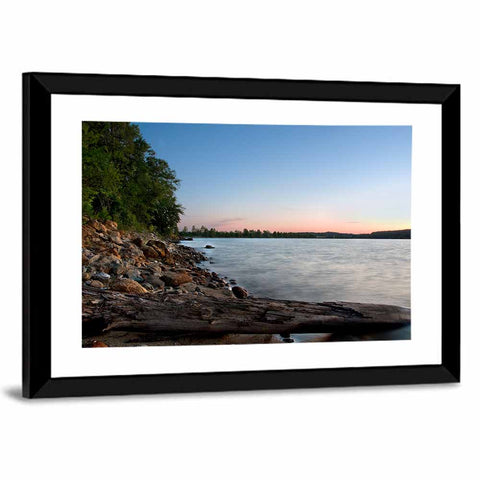
A frame adds weight, so weigh a Framed Canvas instead of guessing from the Canvas Print of the same size. Our canvas vs framed print comparison covers the choice between a canvas and a framed print.

Which Hanging Hardware Is Best for Canvas Art?
Use a sawtooth hanger on a small, light canvas and D-rings with wire on a larger one. Canvas Prints from CanvasPiece arrive ready to hang, so look at the back first, then match the hook on the wall to what is fitted.
Picture Hooks
A picture hook is a steel hook with an angled hole for its nail. A nail driven in at that downward angle grips better than one hammered in straight. The pack prints a weight rating, so compare it with your scale reading.
Sawtooth Hangers
A sawtooth hanger is a metal strip with a row of teeth, fixed to the middle of the top bar of the wooden frame. It hooks over a nail or screw head and sits close to the wall. Christie's guide to hanging art recommends double fixings, one on each side, over a single central one, so use two hangers on a wide canvas.
D-Rings and Picture Wire
D-rings are small metal loops screwed into the sides of the wooden frame, about a third of the way down, with coated picture wire strung between them. The wire rests on one or two hooks, so you can slide the canvas sideways to level it. A canvas hanging kit bundles rings, screws and wire; buy wire rated for twice the weight.
Corner Canvas Hangers
Corner canvas hangers are small brackets that fix to the top corners of the frame. A pair gives two fixed points, so the canvas cannot swing, and there is no wire to adjust. Check the pack for the weight and wall type it suits.

What Hardware Works on Drywall, Plaster, Brick and Concrete?
Drywall takes picture hooks, with studs or toggle bolts for heavy canvases. Plaster needs a pilot hole first, and brick or concrete needs masonry anchors. Find your wall down the side of the table and the longest side of your canvas across the top.
| Wall type | Up to 24 inches (12x8, 16x16, 24x16) | 30 to 36 inches (30x20, 36x24, 36x36) | 48 to 60 inches (48x32, 60x20, 60x40) |
|---|---|---|---|
| Drywall | One picture hook or sawtooth hanger | Two picture hooks or two sawtooth hangers | Two screws into studs, or two toggle bolts |
| Plaster | One hook in a drilled pilot hole | Two hooks in pilot holes | Two screws into studs, or two toggle bolts |
| Brick or concrete | A brick clip, or one masonry anchor | Two masonry anchors with screws | Two masonry screws set with a hammer drill |
Size stands in for weight. Move one column to the right if your scale reads high, as it often does for a Framed Canvas.
Drywall
Drywall is gypsum board, usually half an inch thick, over wooden studs that typically sit 16 inches apart on center. A screw into a stud holds the most; find studs with a stud finder, or tap along the wall for a solid, dull sound. Between studs, use a hollow-wall anchor such as a self-drilling threaded anchor or a toggle bolt. Over a bed or crib, use studs or toggle bolts whatever the weight.
Plaster
Plaster, common in older homes, is hard but brittle, so a hammer blow can crack it. Press an X of painter's tape over the spot, drill a small pilot hole, then drive in the nail or a screw. Put a heavy canvas on a screw in a stud or on toggle bolts, not on plaster alone.
Brick and Concrete
Use a masonry bit, and a hammer drill if you can borrow one. In brick, drill into a mortar joint rather than the brick face, since mortar is softer and easier to patch. If the mortar crumbles, drill into the brick. A plastic masonry anchor suits a medium canvas; masonry screws suit a heavy one.
Watch out: Never drill straight above or below an outlet or light switch, because cables usually run in those lines. Shift the hook sideways to a clear stretch of wall.

How to Hang Canvas Art With Wire and Two Hooks, Step by Step
Mark the hook height, set two hooks one third of the width in from each end, and hang the wire over both. You need a pencil, a tape measure, a level and a stud finder.
- Weigh the canvas and buy hooks rated for twice that weight.
- Choose the center height: 57 to 60 inches from the floor, or 6 to 10 inches above a sofa. Add half the canvas height to find the top edge.
- Pull the wire up to where the hooks will hold it (or find the sawtooth notch) and measure down to the top edge. Subtract that drop from the top edge height to get the hook height.
- Mark the hooks one third of the canvas width in from each end. On a 48 inch canvas that puts them 16 inches apart.
- Run a stud finder across the marks, move a hook onto any stud within an inch or two, and drive the hooks or screws.
- Lift the canvas and lower the wire onto both hooks.
- Rest a small level on the top edge, nudge the canvas until the bubble centers, then press a rubber bumper onto each bottom corner.
Say a 48x32 inch canvas reads 9 pounds. That is the middle band, so buy two hooks rated for 18 pounds or more. One third in from each end puts them 16 inches apart, the usual stud spacing, so both can take screws. Centered at 58 inches, the top edge sits at 58 plus 16, or 74 inches. The taut wire sits 3 inches below the top, so each hook goes in at 71 inches.
How Do You Hang a Large Canvas by Yourself?
Fix the hooks first, then lift the canvas once. Size the piece to the wall before you buy hardware; our wall art size guide gives widths for sofas, beds and consoles. A canvas with a side of 48 inches or more, such as a 48x32 landscape, is awkward alone because the span flexes as you lift.
Pro tip: Cut kraft paper or taped newspaper to the canvas's exact size, mark the hook positions on it and tape it to the wall. Step back, slide it until it looks right, then mark the wall through the paper. A mistake costs a sheet of paper, not a hole.
Put both hooks into studs where you can. Hold the canvas by its bottom corners with your arms spread, raise the wire above both hooks and lower it slowly. With a helper, hold one side each and lower the wire together.
Panoramic canvases run from 24x8 to 60x20 inches. A 48x16 fits above a 64 inch loveseat, where two thirds to three quarters of the width is 43 to 48 inches. Browse our panoramic wall art for the wide shape.

How Do You Hang an Unframed Canvas Without Wire?
Use a sawtooth hanger or a pair of corner hangers on the top bar of the wooden frame. A canvas needs no outer frame to hang, because the wooden frame inside it carries the hardware. Both hold the canvas close to the wall with no wire above the top edge.
A 30x20 inch piece from our coastal wall art is wide enough to tilt on one nail, so fix two sawtooth hangers 6 inches in from each end and hang them from two nails exactly 18 inches apart. Mark both nail spots with a level so they sit at the same height.
Can You Hang Canvas Art Without Nails or Drilling?
Yes, for light canvases. Adhesive strips suit a canvas under about 6 pounds on a smooth, clean, painted wall, and the weight on the pack is the limit. A Poster Print is paper, the lightest of the four finishes, so it suits strips best. A heavier canvas, a textured wall or a steamy bathroom needs a ledge, a lean or a proper fixing; our guide to hanging pictures without nails covers five methods and where each fails.

Every piece is printed to order, with Free Shipping on every US order. Orders reach the door in 8 to 10 business days, so order at least two weeks before the day you want it on the wall.
Quick answers
Common Questions
How do I hang a canvas print on the wall?
Weigh the canvas, buy hooks rated for twice that weight, and mark the hook height: center at 57 to 60 inches, plus half the canvas height, minus the drop from the top edge to the wire. Drive the hooks, hang the canvas, level it and add bumpers to the bottom corners. Use two hooks above 24 inches wide.
Does canvas look better framed or unframed?
Neither is better, so match it to the room. An unframed canvas gives a clean, light edge for modern and casual rooms, while a framed canvas adds a defined border for traditional or formal ones. CanvasPiece sells both, as a Canvas Print and a Framed Canvas. A frame adds weight, so weigh the framed piece first.
What is the rule of 57 for hanging art?
The rule of 57 puts the center of the art 57 inches from the floor, close to average eye level. The usual range is 57 to 60 inches, with the higher number for tall ceilings. Above furniture, the furniture sets the height: leave 6 to 10 inches between the sofa top and the bottom of the art.
What is the 2/3 rule for wall art?
The 2/3 rule says art above furniture should be about two thirds to three quarters as wide as the piece below it. Over an 84 inch sofa, that is 56 to 63 inches, so a 60x20 inch panoramic canvas fits. Hang its bottom edge 6 to 10 inches above the sofa so the two read as one group.
Where not to hang a picture?
Avoid heat, strong sun and steam: above a radiator, heating vent or working fireplace, in direct afternoon sun, and in a bathroom beside the shower. Also skip the wall behind a door that swings open, narrow hallways where people brush past, and the space above a stove, where grease settles on the canvas.