

The best music room ideas start with one large piece of wall art that matches how you play, sized to the furniture below it and lit by a warm, dimmable lamp. Hang it with its center 57 to 60 inches from the floor, pick colors that suit the wall behind it, and group smaller prints beside any wall-hung instruments.
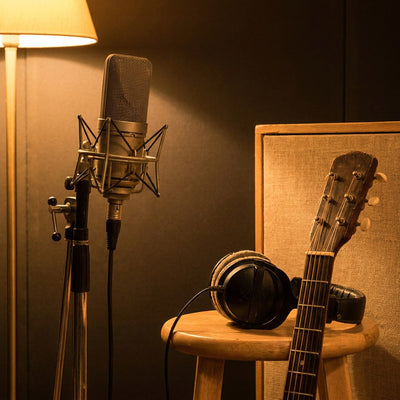
- Match the subject to how you play: studio microphones for a recording corner, sheet music and keys for a piano room, a guitar in warm light for a rock den.
- Size the art to what sits below it: a 36x24 or 48x32 inch landscape canvas over a 60 inch keyboard stand, a 60x20 inch panoramic over a sofa or daybed.
- Hang art with its center 57 to 60 inches from the floor, and leave the wall spots your sound treatment needs free before you place anything.
- Warm 2700K bulbs on a dimmer, with one small spot aimed at the canvas, give you a bright practice mode and a low writing mode from one switch.
- Black and white art suits a charcoal wall, and warmer pieces suit navy.
What Wall Art Does a Music Room Need?
A music room needs one focal piece of wall art, a size that suits the furniture below it, a light that shows it and a few smaller prints for the other walls. A spare bedroom, a basement corner or a garage bay can all work, because the art goes on whatever wall you have.
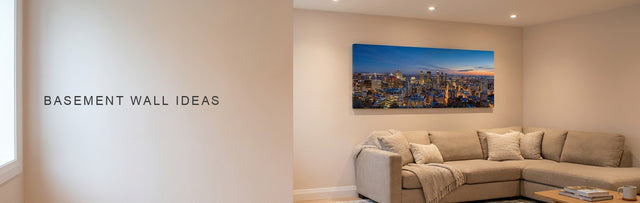
Start with the empty wall. Clap once in the room: a sharp, ringing echo tells you the walls are bare, and a bare wall is also the best place to see where a canvas will go. Stand where you play and note which wall you face most often. That wall takes the main piece, because it is the one you look at between takes. A basement is often the quietest spot, and basement wall ideas for low ceilings covers dry walls and low ceilings for hanging art.

Where Should Wall Art Go in a Room With Sound Treatment?
Hang art on the wall space your sound treatment leaves free, and plan the two together. Many music rooms carry absorbing boards on the side walls, bass traps in the corners and a bookcase on the back wall. Wall art goes on the stretches between and above them: the wall behind the keyboard, the wall above a daybed, the strip beside the door.
Mark the treatment positions first. Sit where you play, have a friend slide a hand mirror along the side wall at ear height and mark every spot where you can see a speaker or the instrument in the mirror. Those first reflection points are where absorbing boards go, so keep them clear and hang art on the wall around them. Then size each piece to what sits below it, using the table.
| Wall spot | What sits below | Art width to aim for | Closest sizes |
|---|---|---|---|
| Behind the keyboard | 60 in keyboard stand | 40 to 45 in | 36x24 or 48x32 landscape |
| Above a daybed | 72 in daybed | 48 to 54 in | 48x32 landscape, 48x16 panoramic |
| Above a long sofa | 84 in sofa | 56 to 63 in | 60x20 panoramic |
| Above a desk | 48 in desk | 32 to 36 in | 36x24 landscape |
Pick the larger size when the wall is bare on both sides, and the smaller one when a speaker or lamp sits close to the edge.
Pro tip: Cut sheets of paper to the size of each piece of art, tape them to the wall and live with them for a day. Then mark the sound treatment around them. It is cheaper to move paper than to patch holes.
Watch out: Wall art is not sound treatment. A canvas will not fix an echo or keep a drum kit from reaching the neighbors, so treat the room's sound with the right materials and use the art for how the room looks.
What Colors Should Music Room Wall Art Have?
Choose the colors in the art for the mood you want to play in, then keep the rest of the room muted so the instruments and the art carry the color. Deep navy and charcoal walls make a room feel like a listening space, and a print with warm amber, copper or cream tones stands out against them. On warm white or soft gray walls, art in deeper tones holds its own.
Bright reds and oranges in a print energize a room, and blues and greens calm it. For a room that serves rock, jazz and classical, hang a neutral piece and let one canvas set the accent. Our black and white art suits a charcoal wall, and warmer pieces suit navy. In a small room, one dark wall with a lighter print on it makes the art the center of attention.

How Should You Light Wall Art in a Music Room?
Use layers: a dimmable overhead on warm 2700K bulbs, a task lamp at the music stand or keyboard, and one accent light aimed at the art. The overhead on full gives you a bright practice setting. Dimmed to 20 percent, the same fixture leaves the accent light on the canvas as the glow of the room during a late-night writing session.
Aim a small adjustable spot at a canvas or a wall-hung guitar from above and slightly in front of the wall. LED strips behind a shelf or along the top of a wall add a glow without a visible bulb, and they light a print without a spot on the ceiling. Avoid fluorescent tubes, which can hum and bring a faint electrical noise into recordings.
Take a 12 by 14 foot spare room with 8 foot ceilings and a 72 inch daybed on the 14 foot wall. Two thirds of 72 is 48, so a 48x32 inch landscape canvas fits at 67 percent of the width. The daybed back is 30 inches tall, and the bottom edge of the art hangs 8 inches above it, at 38 inches. The top edge lands at 70 inches and the center at 54 inches. One spot on a ceiling track, aimed at that center, lights the whole piece.
How Do You Hang Instruments Beside Wall Art?
Mount guitars on wall hangers screwed into studs, hang them at eye level and give each one at least 6 inches of space on either side. A guitar on the wall is decor and storage in one, and a print beside it makes the group read as a display rather than a storage rack.
Use a stud finder, because a plaster anchor will not carry a guitar. Plan the art around the studs: the hangers go where the studs are, and the prints fill the wall between them. Keep acoustic guitars away from direct sun and heating vents, and aim for relative humidity between 40 and 60 percent, since dry air cracks wood. A cheap hygrometer on the wall tells you. Violins, ukuleles and small drums also hang well, and a print of the same instrument beside them ties the wall together. Our guide to art in a workspace covers the same eye-level rule for a desk wall.
- Mark stud positions with painter's tape before you pick hanger spots or art spots.
- Leave 6 inches between hangers and the print beside them, and 4 inches from the ceiling or a door frame.
- Put the heaviest instrument closest to a stud pair, not to a corner.
- Check the hanger weight rating against the instrument and its case.
- Line up the center of the print with the center of the guitar body so the group reads as one line.
What Wall Art Suits a Music Room?
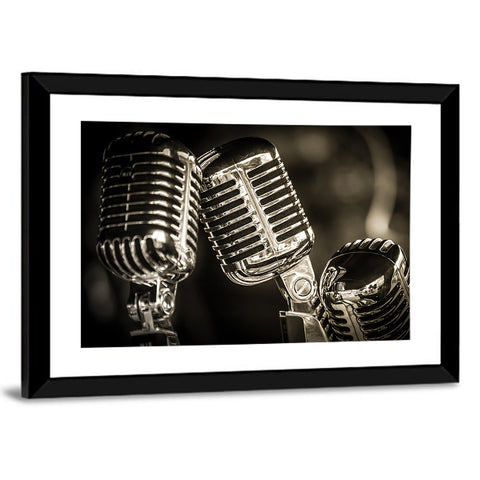
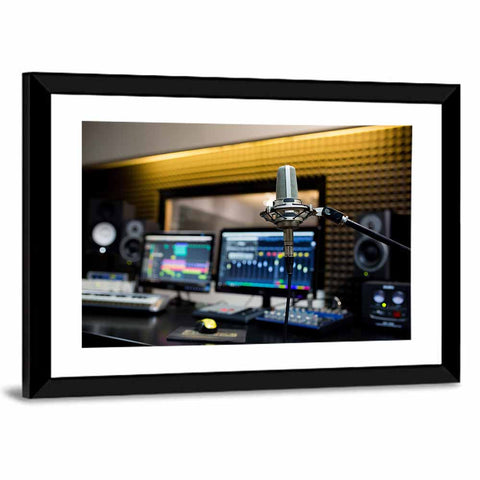
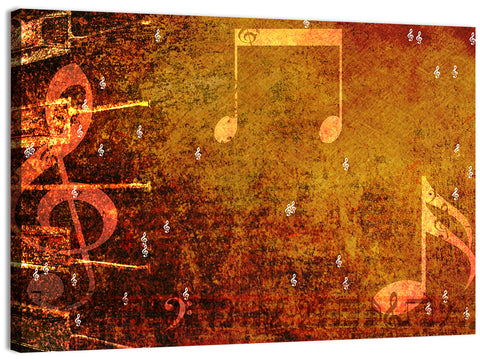
Pick subjects that match how you play: vintage studio microphones for a recording corner, sheet music and keys for a piano room, a guitar in warm light for a rock den. Choose one large piece as the focal point and fill the rest of the wall with smaller things, rather than covering the wall edge to edge.

Size the piece to what sits below it. Above a 60 inch keyboard stand, a 36x24 or 48x32 inch landscape canvas sits well. Above a sofa or daybed, a 60x20 inch panoramic carries a wide wall. Canvas has no glass front, so it adds no hard reflective surface to the room. Browse our music wall art for guitars, keys and microphones, and vintage wall decor for a warmer, older look.

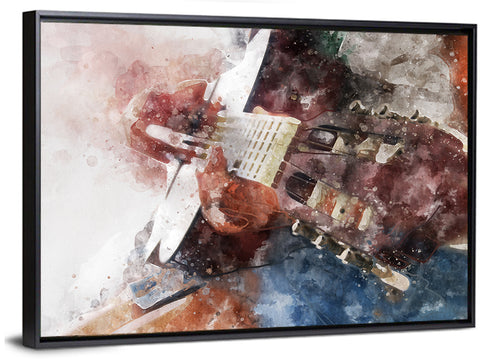
A gallery wall works for smaller pieces. Keep 2 to 3 inches between prints, align the group to a center line at 57 to 60 inches from the floor and leave any sound treatment visible as part of the design. A wall that mixes a microphone print, a sheet music collage and a guitar watercolor reads as a studio, not a shrine.
How Big Should Art Be in a Small Music Room?
A small music room needs fewer pieces of art, sized to the furniture below them. One 24x16 or 30x20 inch canvas above a desk does more than six small frames. Keep walkways at least 30 inches wide so you can step back from the piece, and keep the sightline to your music stand clear.
Use the wall space above the door or a shelf for a wide, low piece: a 48x16 inch panoramic stretches the wall without taking floor space. A dark piece on a light wall gives the small room a focal point, and a Framed Canvas gives the edge a firmer line than a plain Canvas Print. Pick one or the other for the whole wall so the room does not look busy.

Which Wall Art Suits a Music Themed Party?
For a music-themed birthday, hang a wide print behind a stage corner and let it set the genre. A poster of a studio microphone, a guitar or a sheet music collage costs little and reads at once, and a few Poster Prints in different sizes fill a stage wall.
A Poster Print is the lightest option for a party wall, and it can come down when the room goes back to work. For a room you keep, a canvas lasts. Our guide to room changes that take an afternoon shows how to move one piece of art without repainting.
Every piece is printed to order and ships free across the US. Pick a shape for your wall and a finish for your room.
Quick answers
Common Questions
What do you need for a music room?
You need a quiet room, one focal piece of wall art, warm dimmable lighting, safe wall mounts for instruments and a few smaller prints. Add rugs and heavy curtains if the room echoes. Start with the art and the wall it goes on, because that wall decides where everything else fits.
How do you make a small studio look big?
Choose one wide piece of wall art, such as a 48x16 inch panoramic, and keep the rest of the wall clear. A single large piece makes a small room look planned, while six small frames make it look busy. Pair a lighter wall with a darker or warmer print so the art becomes the focus.
How do you make your room look like a studio?
Hang a studio microphone print as the focal point, mount guitars at eye level beside it and light the wall with a small spot on a dimmer. Keep cables tidy with clips and a shelf for gear. A dark wall with a black and white print gives the strongest studio feel for the least work.
What are some good ideas for decorating a studio room?
Choose one large canvas of a microphone, piano keys or sheet music, hang guitars at eye level and add LED strips behind shelves. Leave the wall spots your sound treatment needs free, and plan the art around them. Keep the colors to two main tones and one accent, and take the accent from the print.
What are some good music-themed birthday decorations?
Hang a large music print behind the stage corner, add string lights and a few Poster Prints of guitars, keys or microphones along the wall. A Poster Print makes an easy party wall, and a canvas stays up after the party is over.